
Looking Back: “Driverless Governance”
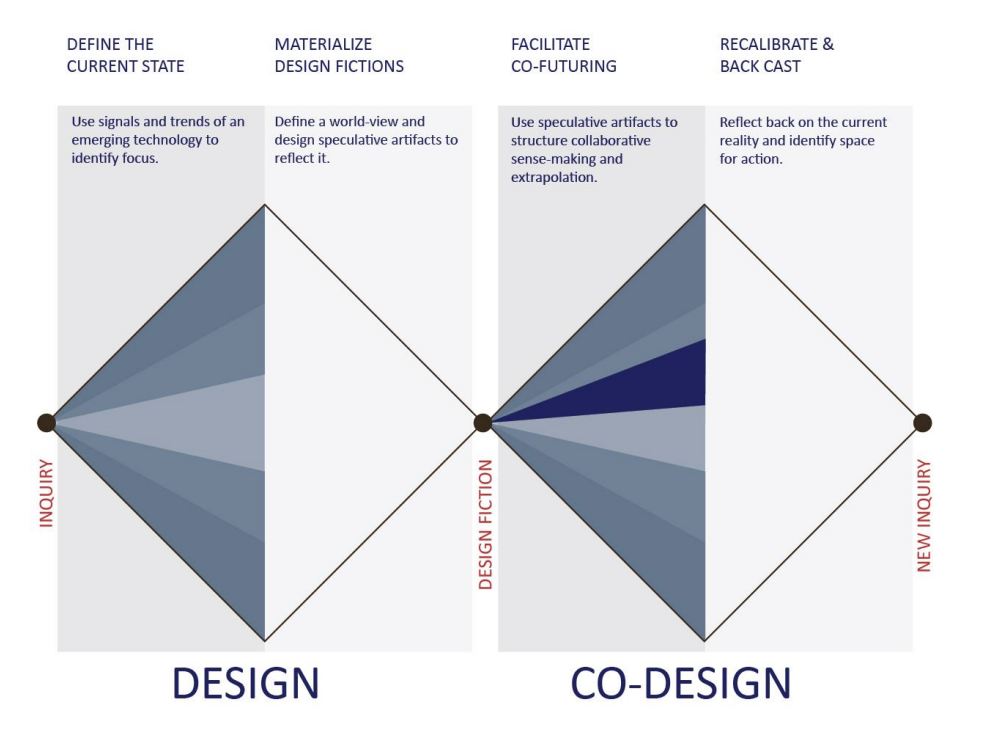
Today, I’m looking back at a piece of work by a student design team from 2017: "Driverless Governance: Designing Narratives Toward Democratic Technology," published in The Design Journal as part of the European Academy of Design’s Design for Next conference proceedings.
I first met the team behind this work—Melika, Winnie, and Corey—at the 2017 VergeNYC Conference at Parsons School of Design, where I supported them on the planning and facilitation of their workshop. In their research, the team dared to ask a deceptively simple question: What if governance were driverless?
They used the question to build an entire platform, "Sparks Laboratory," to speculate on the measures of equality and happiness in a tech-driven future. At the time, their work served as a brilliant example of how designed narratives can function as a mechanism for cooperative future-casting. They explored how pervasive technologies shape our power structures and forms of dissent, and importantly, how that framework could inform policy responses to the ethical dilemmas we face today.
Seeing their work in The Design Journal was a testament to the rigor they brought to those early workshop conversations. They weren't just creating artifacts; they were creating a space for a diverse range of constituents to participate in the forecasting process. The questions they raised about the ethics of predictive analytics and the democratization of future-casting feel even more urgent now than they did nearly a decade ago, in today’s reality of prediction markets and mass electioneering.
Congratulations to Melika, Winnie, and Corey for a piece of work that continues to hold up, inform, and provoke.
